How long will it take for USCIS to decide a case? There is no simple way to find the answer to this. That is, you can’t just go to a USCIS webpage that will give you a definitive answer for a particular case type. With that caveat, though, there are some tools available to help you get an idea of how long it will take for a case to be processed. Our comments here focus on family-based cases since those are our areas of concentration. Did you file an I-485 (adjustment of status), N-400 (naturalization) or N-600 (certificate of citizenship)? If so, skip to this.
1. Identify the Service Center with jurisdiction in your case.
After your application is initially filed it will be forwarded to one of four USCIS Service Centers distributed across the United States. Each Service Center has jurisdiction over a specific specific area. Since processing times vary by Service Center, the first step is to identify the Service Center with jurisdiction over your case. As of the time of writing, here is a list of Service Center jurisdiction organized by state/territory.
Important note: USCIS periodically transfers cases between service centers to even out case load. Depending on the policies in place at a particular point of time it is possible that your case would end up at a different Service Center. But the best you can do for purposes of estimating case processing time is to start with the list below.
- Alabama (Texas Service Center)
- Alaska (Nebraska Service Center)
- Arizona (California Service Center)
- Arkansas (Texas Service Center)
- California (California Service Center)
- Colorado (Nebraska Service Center)
- Connecticut (Vermont Service Center)
- Delaware (Vermont Service Center)
- District of Columbia (Vermont Service Center)
- Florida (Texas Service Center)
- Georgia (Texas Service Center)
- Guam (California Service Center)
- Hawaii (California Service Center)
- Idaho (Nebraska Service Center)
- Illinois (Nebraska Service Center)
- Indiana (Nebraska Service Center)
- Iowa (Nebraska Service Center)
- Kansas (Nebraska Service Center)
- Kentucky (Texas Service Center)
- Louisiana (Texas Service Center)
- Maine (Vermont Service Center)
- Maryland (Vermont Service Center)
- Massachusetts (Vermont Service Center)
- Michigan (Nebraska Service Center)
- Minnesota (Nebraska Service Center)
- Mississippi (Texas Service Center)
- Missouri (Nebraska Service Center)
- Montana (Nebraska Service Center)
- Nebraska (Nebraska Service Center)
- Nevada (California Service Center)
- New Hampshire (Vermont Service Center)
- New Jersey (Vermont Service Center)
- New Mexico (Texas Service Center)
- New York (Vermont Service Center)
- North Carolina (Texas Service Center)
- North Dakota (Nebraska Service Center)
- Ohio (Nebraska Service Center)
- Oklahoma (Texas Service Center)
- Oregon (Nebraska Service Center)
- Pennsylvania (Vermont Service Center)
- Puerto Rico (Vermont Service Center)
- Rhode Island (Vermont Service Center)
- South Carolina (Texas Service Center)
- South Dakota (Nebraska Service Center)
- Tennessee (Texas Service Center)
- Texas (Texas Service Center)
- Utah (Nebraska Service Center)
- Vermont (Vermont Service Center)
- Virginia (Vermont Service Center)
- Virgin Islands (Vermont Service Center)
- Washington (Nebraska Service Center)
- West Virginia (Vermont Service Center)
- Wisconsin (Nebraska Service Center)
- Wyoming (Nebraska Service Center)
2. Find the processing time for your case type at the Service Center.
Now that you’ve found the Service Center that will have jurisdiction over your case, visit the USCIS Processing Time Information page. On the 15th day of each month USCIS posts the latest information about processing times at all Service Centers and other USCIS facilities. Scroll down to the bottom of the page to access the Service Center processing times.
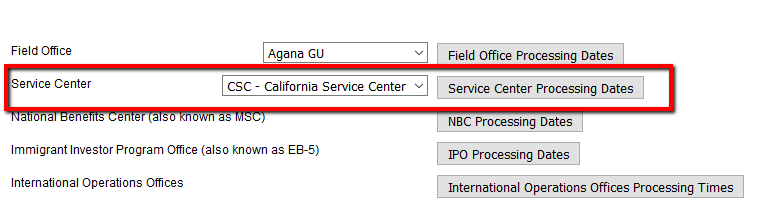
After selecting the appropriate Service Center you’ll be shown a list of the various form types and associated processing times. If the Service Center is operating within its normal processing timeline you will see a timeframe designation given in number of months (e.g., I-129F… 5 months). But if the Service Center is running behind schedule it will show only a date. If you see this, the Service Center is showing the filing date of the applications that it is currently processing (e.g., I-751… March 16, 2015). To figure out what this means in terms of processing time for that form, figure out the duration between the posted date and the date on which the data was uploaded, which is shown at the top of the form. Use the handy tool available here to calculate the duration between those two dates.

Okay, now you’ve got the first number that you need, which is the current Service Center processing time for your form.
3. The rouge factor
Now – unfortunately – it becomes more complicated. From here there are basically three ways your case will progress: (1) no further processing is needed because the Service Center has made the final decision in your case; (2) the application will be forwarded to the local office for further review; or (3) you will be applying for a visa at a US consulate, so the application will be forwarded to the Department of State. In family-based cases, and those seeking naturalization, it will usually be options (2) or (3).
Local Offices.
The two main types of family immigration cases that wind up at local offices are I-485 adjustment applications, and I-751 applications to remove conditions on residence. (For information about I-485s please see below). Unfortunately there is no publicly available data on how fast an I-751 will be set for interview after being sent from a Service Center to a Local Office. These timelines vary dramatically around the country and from month to month at a particular office. Broadly speaking, interviews times can range from a few weeks after an application is received by the Local Office up to multiple months.
Department of State – consulates.
For purposes of our discussion there are two types of cases that will be forwarded to the Department of State (DOS): fiancé cases, and family-based immigrant (permanent) visas such as those based on marriage. For both case types, USCIS first forwards the file to the DOS National Visa Center (NVC). Since the immigration agencies still use paper files this means your papers literally travel to the NVC. At the time of writing it takes about one month for a case file to get to the NVC.
After the file is received by the NVC you will be issued notices to request payment of your visa fees, and after this will be required to file either a DS-160 (fiancé) or DS-260 (immigrant visa) application online with the NVC. You will also be required to provide documentation in support of your case. For this reason, progress at this point is largely determined by how fast you prepare your paperwork.
After paperwork is submitted, processing time varies depending on what type of case you have, and the location of your consulate.
For fiancé visas, supporting documents are submitted at the time of your visa interview at the consulate. This is great news for you, because it means that as soon as your DS-160 is filed your case is on its way to being scheduled. Interview backlogs vary depending on consulate, but are typically in the range of a few weeks to several months from the date a DS-160 is completed.
For immigrant visa (e.g., marriage visa) cases, the story is more complicated. In these cases, supporting paperwork is collected by the NVC, and the case will not be forwarded until all paperwork is accounted for. The problem is that the NVC is often backlogged, and will take a month or more before reviewing submissions. Additionally, the NVC issues requests for additional information in a large number of cases, commonly for questions concerning the Form I-864 Affidavit of Support. Assuming you submitted everything properly, expect the NVC to take at least 1-3 months to review the case, then forward it to the US consulate abroad.
In immigrant visa cases the NVC will schedule your consulate interview once it forwards your case to the appropriate consulate. As with fiancé visas, the scheduling of such interviews varies, but broadly speaking is in the range of multiple weeks to several months.
Special local processing data for forms I-485, N-400 and N-600.
These three forms always require in-person interviews at a USCIS field office, and USCIS tracks local processing times for all three forms. This is great news for you, because it gives you a more specific sense of timeline.
USCIS field offices are located throughout the United States. These Local Offices are responsible for handling immigration applications at the interview stage. Jurisdiction depends on where you live. To find the office where your interview will take place, use the locator tool available here.
Next – as described for Service Centers above – visit the USCIS Processing Time Information page to look at processing data for your field office.
Photo credit: Renjith Krishnan (http://www.freedigitalphotos.net)